
Food Talk Starters for Pakistani Chat
Use Pakistani food questions to start lively, inclusive conversations about recipes, cities, memories, and everyday preferences.
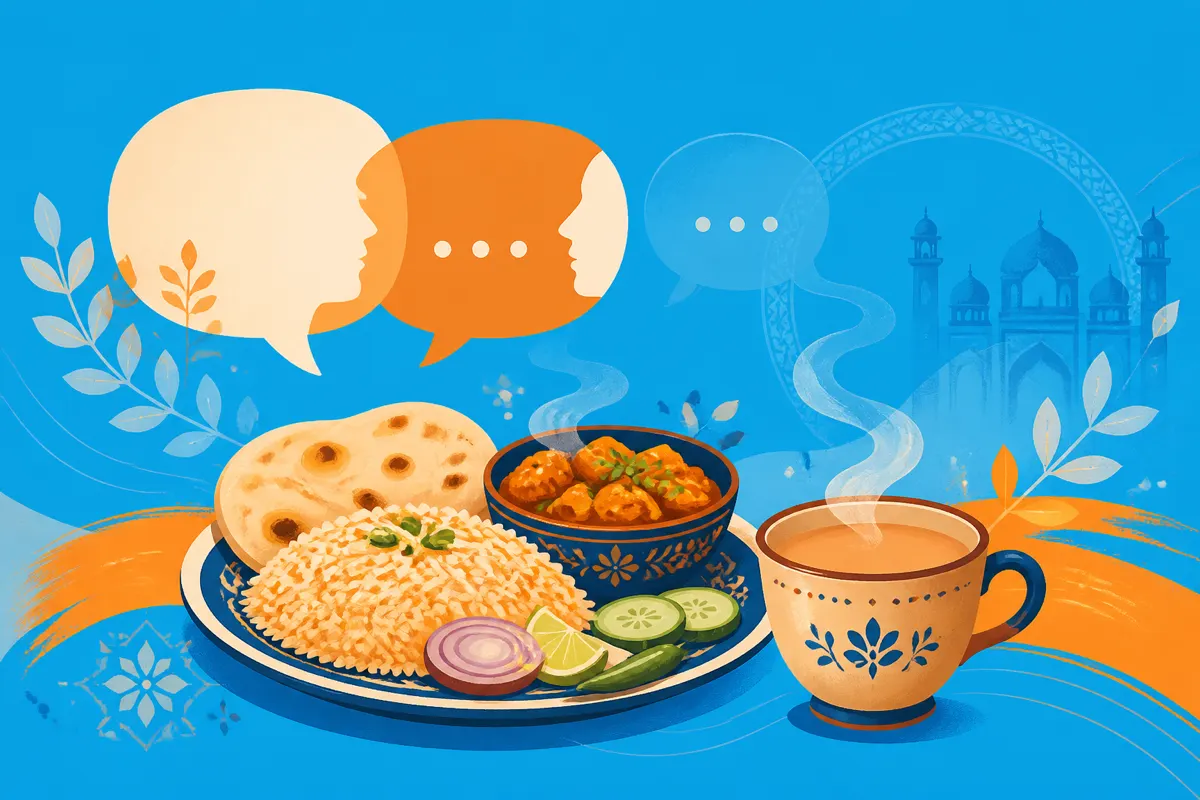
Why food talk starters Pakistani chat deserves a practical approach
Food is an unusually reliable chat starter because everyone can answer at their own level. A person may share a one-word preference, a family memory, a recipe shortcut, or a passionate opinion about biryani. The subject feels familiar without requiring private information.
You can try these ideas in site home. Access is completely free for guests and registered users. There is no payment to enter, talk, open an account, or keep chatting after registration. If you prefer to look around before choosing an account, anonymous chat is a straightforward starting point.
Before joining, read the community guidelines. They set a useful baseline for consent, respect, and behaviour. The online safety page explains what to do when a conversation stops feeling merely awkward and starts feeling unsafe.
Begin with a simple either-or
Ask “paratha or halwa puri for breakfast?”, “doodh patti or black tea?”, or “biryani with aloo or without?” Easy choices lower the effort of joining and naturally lead to reasons and stories.
A useful way to judge the idea is to ask whether it makes the conversation easier for everyone, not only more exciting for you.
For a related perspective, read the personal information guide. It helps separate a useful social habit from a rule that is too rigid for real conversation.
Invite regional knowledge
Try “What food should someone taste in your city?” or “Which winter dish deserves more attention?” This welcomes people from large and small places. Do not treat one answer as representative of an entire province.
The room may move quickly, but you can still pause before replying. A short delay often prevents a message that needs a long apology.
A quick self-check
Before sending the next message, ask three questions: Does this reveal more than I intend? Could it pressure or embarrass somebody? Would I be comfortable seeing it quoted without the surrounding conversation? If any answer worries you, shorten the message or leave it unsent.
Ask about method, not family secrets
Cooking times, spice balance, and beginner mistakes create practical discussion. If someone says a recipe is private or they do not cook, move on. Nobody has to prove cultural authenticity in the kitchen.
Context matters. The same wording can feel different in a busy public room, a small familiar group, and a new private exchange.
People chatting from a phone may also benefit from random chat, especially when notifications, shared screens, weak connections, or late-night use affect the experience.
Make dietary space without interrogation
People may avoid foods for religion, health, allergy, cost, ethics, or taste. Offer alternatives and skip personal medical questions. Mocking what someone can afford or eat quickly ruins an otherwise welcoming topic.
Do not measure success by how much personal information people exchange. A pleasant, general conversation is a complete social experience.
What a healthy response looks like
A considerate person does not demand instant access, perfect agreement, or a detailed explanation for every boundary. They can laugh without targeting somebody, disagree without collecting supporters, and let a conversation end. Those ordinary reactions tell you more than an impressive introduction.
Use memories with care
School canteen snacks, Eid dishes, train food, mango seasons, and a grandparent’s cooking can produce warm stories. Remember that family and home topics may also carry grief. Let the speaker choose how deep to go.
Pay attention to how other people respond to limits. Respectful users accept a no, a slow reply, or a topic change without making it a test.
If the issue involves information about you, review the privacy information and the privacy FAQ. Platform information and personal choices are different topics, and understanding both leads to better decisions.
Turn disagreement into recommendations
Instead of fighting over the single best restaurant or recipe, ask each person for a favourite and why. A useful list is a better outcome than a city war. Keep exact meet-up plans and home addresses out of public chat.
Small habits are more reliable than dramatic promises. Clear wording, patience, and ordinary courtesy create the conditions for better chat.
Picture a common chat-room moment
Imagine the room is active and the subject turns to “ask about method, not family secrets”. Several people answer at once, one person disagrees sharply, and another asks you a personal follow-up. You do not have to handle all three events. Reply to the safe public topic, ignore the identifying question, and give the disagreement time to cool.
Now imagine the room is almost empty. The principle in “turn disagreement into recommendations” becomes more important because a private-feeling atmosphere can encourage oversharing. A public room remains public when only two people are typing. Keep the same privacy boundary you would use in a crowd.
These scenarios are worth rehearsing because pressure often arrives as speed rather than an obvious threat. Knowing your next step in advance makes it easier to act calmly. You can pause, redirect, leave, block, or report without waiting for unanimous approval.
Keep the wider situation in view
Advice about food talk starters Pakistani chat works best when it supports the rest of your life. Hunger, tiredness, loneliness, exam pressure, work stress, and excitement can all change how a message feels. If you notice yourself reacting much more strongly than usual, step away from the screen for a few minutes. Drink water, move around, or speak to somebody you already trust. Returning with a calmer mind is not losing an argument.
Remember the connection between “invite regional knowledge” and “use memories with care”. One concerns the choice you make in the moment, while the other helps you judge the pattern around it. A single clumsy sentence may be repairable. Repeated pressure, contradictions, humiliation, or attempts to isolate you deserve a firmer response. Look at behaviour across the conversation instead of letting one compliment erase several warning signs.
There is also a difference between discomfort and danger. Mild awkwardness can sometimes be solved with clarification. Threats, blackmail, sexual coercion, fraud, stalking, identity exposure, and persistent harassment call for protective action. Preserve only the evidence you need, use the available safety tools, and involve a trusted person or appropriate local support when the risk extends beyond the room.
Finally, apply the same standard to yourself. Do not chase replies, demand personal proof, repost somebody's messages for entertainment, or treat a stated boundary as an invitation to negotiate. Safer communities are built by users who protect their own limits and recognise the limits of others.
A simple plan for your next chat
Begin with one idea from this guide rather than trying to remember everything. Join a suitable room through free chat, observe the tone, and take part without rushing to become memorable. If the exchange is pleasant, let it develop at an ordinary pace. If it is not, move on.
Keep a few non-negotiable limits. Do not send passwords, verification codes, financial details, identity documents, private images, or a live location. Do not accept pressure as proof of friendship. When another user states a limit, give them the same respect.
The healthy friendship guide offers another useful view if you are still finding your style. Good chat is not built from perfect lines. It grows from attention, proportion, humour that includes people, and the confidence to stop when a conversation no longer feels right.
Final thought
Food Talk Starters for Pakistani Chat is ultimately about making online time easier to enjoy and easier to leave. Stay open to ordinary connection while keeping control of your identity, schedule, and attention. The most rewarding rooms are not those where everyone shares the most. They are the ones where people can participate, disagree, pause, and return without pressure.