
Respecting Pakistan's Different Provinces in Online Chat
How to enjoy provincial pride, language, food, sport, and cultural differences in Pakistani chat without stereotypes, insults, exclusion, or argument loops.
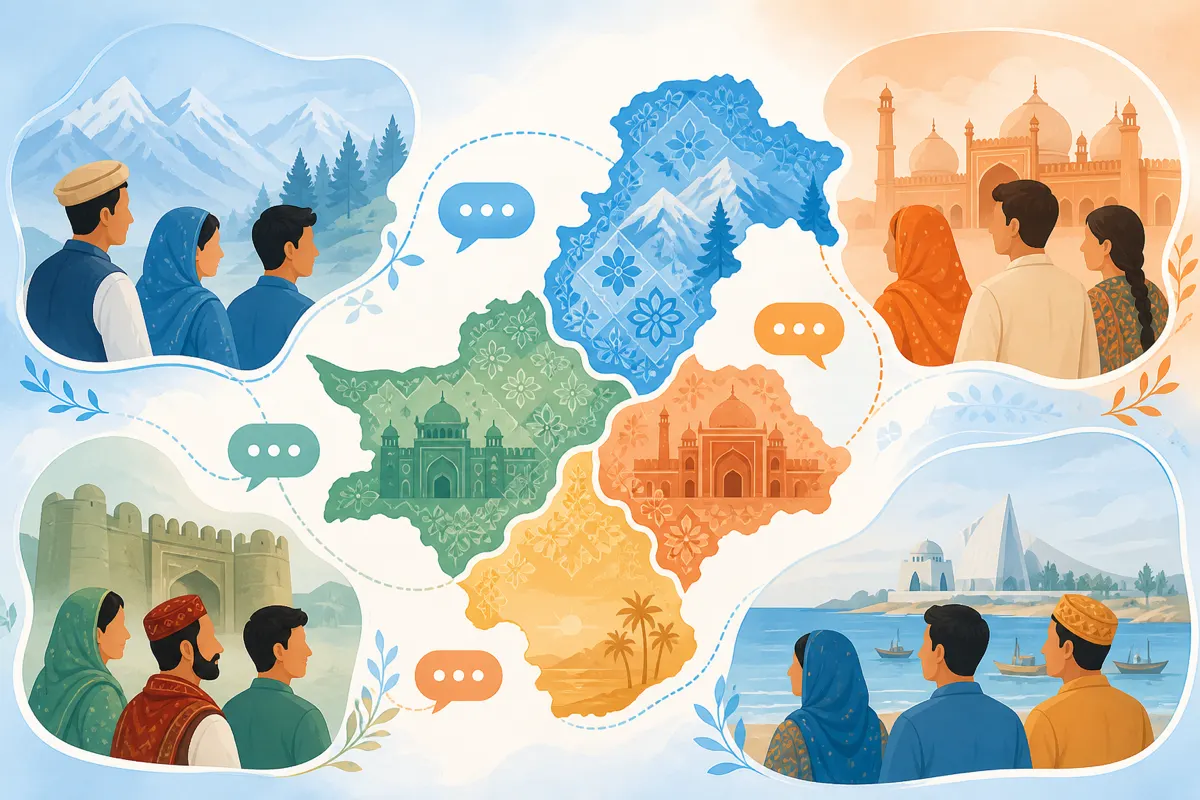
Pakistan's provinces and regions offer an endless supply of conversation: food, languages, music, weather, cricket, university life, travel, and local humour. These differences can make an online room lively. They can also become an excuse for stereotypes.
Respect does not require pretending every place is identical. It means discussing real differences without treating millions of people as one personality.
Enjoy pride without creating a ranking
It is natural to praise your city or province. Tell people why you love Sindhi ajrak, Balochi hospitality, Punjabi folk music, Pashtun food, Gilgit-Baltistan's landscapes, or Kashmir's traditions. Specific appreciation gives others something to respond to.
Problems begin when pride becomes a claim that another group is less intelligent, less loyal, less cultured, or less deserving. “My favourite biryani is from Karachi” invites a debate. “People from your province have no taste” attacks identity.
Try swapping rankings for comparisons:
- Which local breakfast would you recommend to a visitor?
- What word from your language should more Pakistanis know?
- Which season shows your city at its best?
- What stereotype about your area is inaccurate?
These questions let people represent their own experience.
Treat language as belonging
Pakistani rooms may include Urdu, English, Punjabi, Pashto, Sindhi, Balochi, Saraiki, Hindko, Brahui, Shina, Balti, Kashmiri, and many other languages. Language is not evidence of intelligence or patriotism.
Do not mock an accent, spelling, or Roman-script variation. A person may be fluent in speech but unfamiliar with typing. Overseas Pakistanis may understand family languages without writing them confidently.
If a long exchange excludes most of the room, offer a short translation of the main point where practical. Do not demand that friends abandon their language completely. Balance inclusion with the freedom to express culture.
Urdu and English chat mixing offers practical ways to keep multilingual conversations readable.
Question stereotypes, including flattering ones
Negative stereotypes are easy to identify, but flattering labels can also flatten people. Saying every member of a province is brave, wealthy, generous, conservative, humorous, or business-minded creates expectations that individuals did not choose.
When someone tells you where they are from, ask about them rather than reciting what you have heard. “What do you enjoy about living there?” is better than “So you must be like this.”
Be careful with jokes based on conflict, displacement, security, poverty, sect, or ethnicity. These subjects affect real families. They are not harmless simply because the speaker adds a laughing emoji.
The community guidelines should apply equally whether a targeted group is large or small.
Avoid making one person a spokesperson
No chatter can explain an entire province. A university student in Quetta, a shopkeeper in Lahore, and a teacher in rural Sindh each speak from a particular life.
Ask, “What has your experience been?” rather than “Why do your people do this?” If two people from the same place disagree, accept that both experiences can be genuine.
This is especially important during political discussions. Provincial policies, resource distribution, language rights, and representation are legitimate topics. Keep claims specific, use reliable sources, and criticise decisions without insulting populations.
If the conversation becomes circular, use the steps in avoiding argument loops online.
Make city rooms welcoming to visitors
Local rooms such as Karachi chat, Peshawar chat, Quetta chat, and Lahore chat naturally centre local life. They can still welcome people from elsewhere.
When a visitor asks a basic question, answer without making them feel foolish. Explain local references and recommend safe, general topics. Do not pressure anyone to prove they live in the city through an exact address, workplace, or photograph.
City chat rooms explained shows how local context can start conversations while privacy stays intact.
Handle humour through consent and context
Friends often tease one another about food, cricket teams, pronunciation, or weather. The relationship and tone matter. A joke welcomed by close friends may feel hostile when aimed at a newcomer.
Watch the response. If the person stops participating, objects, or changes tone, do not repeat the joke to force them to laugh. Say, “That did not land well. Sorry,” and move on.
Avoid dogpiling. Ten people repeating the same joke at one user turns banter into targeting. Group humour without hurting people provides a fuller guide.
Respond when prejudice appears
You do not need a long speech every time. A calm interruption can reset the room:
- “Let us criticise the policy, not people from the province.”
- “That stereotype is not fair.”
- “Please do not use that slur here.”
- “One person's behaviour does not represent a whole region.”
Moderators should act consistently. If a slur violates the rules when aimed at one group, it should violate them when aimed at another. Friendship with a long-time member should not protect repeated abuse.
For threats, targeted harassment, or attempts to expose personal information, stop engaging and use reporting tools. Review the safety page and how to report abuse.
Build shared topics without erasing differences
Cricket, music, dramas, recipes, education, travel, and everyday humour can connect people across geography. Shared interests do not require everyone to agree.
Try a round where each person recommends one local dish or song. Compare how Eid, weddings, or winter evenings look in different places. Ask diaspora members what regional traditions their families keep abroad.
These conversations work when curiosity is genuine. Do not collect cultural facts merely to challenge or correct the person sharing them.
Keep access equal
FreePakistaniChat is completely free for guests and registered users. Guest login and accounts are both free, with no payment required to join, talk, or continue after registration.
Equal access should be matched by equal welcome. A guest from a smaller city deserves the same respect as a familiar account from a major centre. Explore Pakistani chat with the understanding that no single room, language, or province represents the whole country.
Provincial pride is at its best when it adds colour to conversation without narrowing anyone's humanity. Be specific, ask rather than assume, correct prejudice early, and leave people free to define themselves.